Some of the most common skin issues that bother people include skin pigmentation, acne scars, uneven skin tone, melasma, freckles, and even undesired tattoos. Because of advances in dermatology, laser therapy has become one of the safest ways to get clearer, more youthful skin.
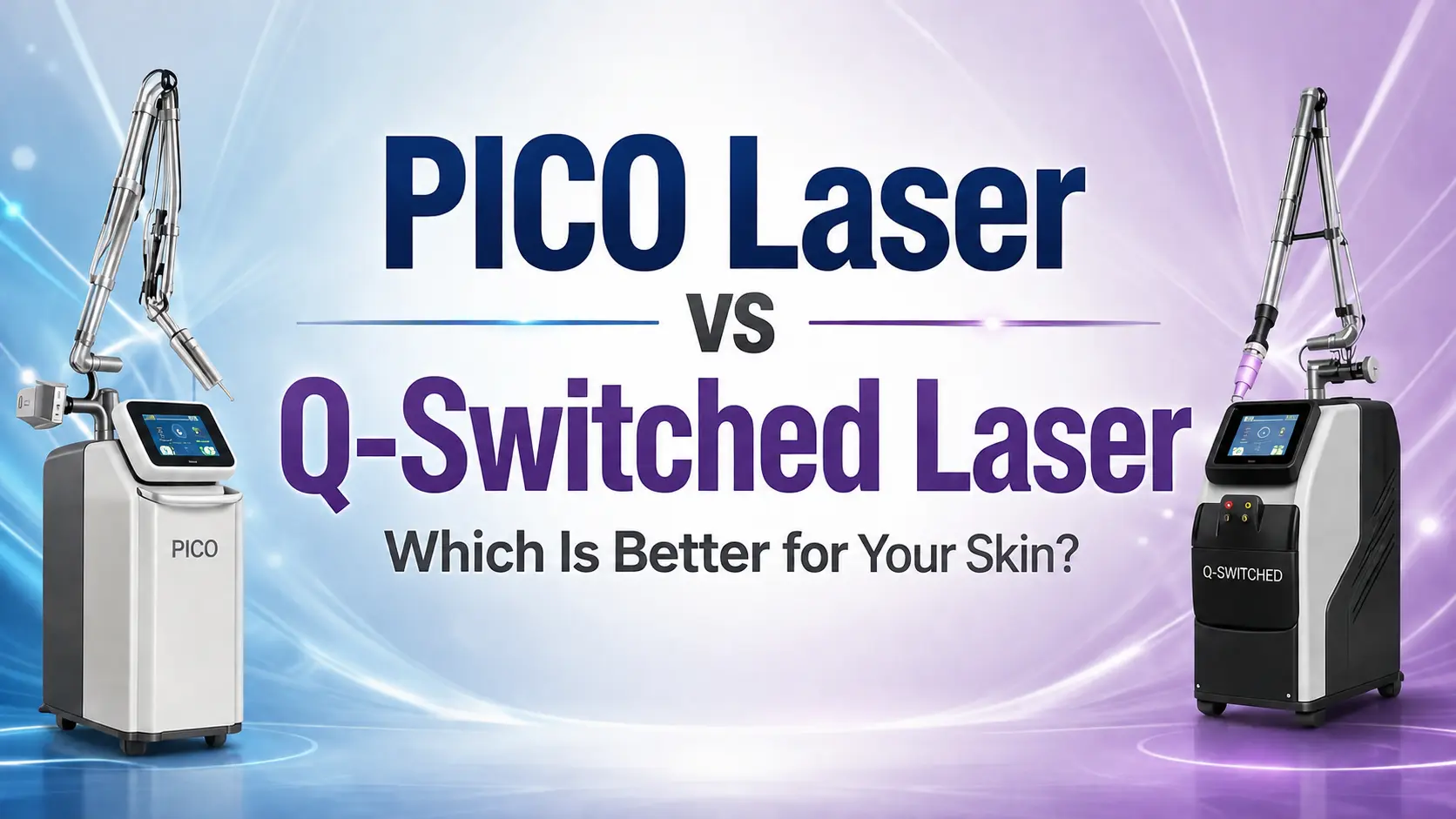
There are many types of lasers that are currently in use, two of the most popular being PICO Laser and Q-Switched Laser. Both lasers are popular and can treat many skin issues, but they work differently and produce different results.
Have you ever wondered “What’s better, PICO laser or Q-switched laser?” This guide can help you out.
What Is A PICO Laser?
PICO Laser is one of the most recent technologies developed in the field of cosmetic dermatology. The laser sends out ultra-short pulses measured in picoseconds (which is equal to one trillionth of a second).
Unlike the conventional lasers that use heat to break down pigmentation, PICO Laser generates a highly efficient photo-acoustic effect, which breaks down pigmentation into micro-particles. The particles get naturally flushed out by your immune system.
This procedure results in minimal heat generation, which makes the treatment safe and more effective.
The PICO Laser can be used for treating the following:
- Pigmentation
- Melasma
- Sunspots
- Freckles
- Acne scars
- Skin rejuvenation
- Pore size reduction
- Tattoo removal
- Fine lines
- Irregular skin tone
What Is A Q-switched Laser?
Q-switched lasers have long been known as effective treatments in dermatology. This technology sends the laser energy in nanoseconds (a billionth of a second) to destroy excess melanin and tattoo pigments. This procedure affects pigmented lesions but does not damage the surrounding areas.
Even though this technology still shows great results in the treatment of numerous pigmentation problems, it usually takes more sessions than PICO Laser technology that was introduced later.
Common uses of Q-switched lasers include the following:
- Melasma
- Pigmentation
- Age spots
- Sun damage
- Freckles
- Birthmarks
- Tattoo removal
- Skin brightening
How Does This Laser Work?
PICO Laser Technology
PICO Laser operates mainly through the photoacoustic effect. Rather than using too much heat on the skin, it causes shock waves that cause the pigment to be broken into very tiny particles.
Benefits of Pico Laser are:
- Less tissue damage
- Rapid healing
- Collagen stimulation
- Skin texture improvement
- Downtime is minimal.
Q-Switched Laser Technology
A Q-switched laser works through the photothermal effect. It causes the use of heat that breaks down the pigmentation. Although it is quite effective, it usually causes more healing time due to the extra heat produced.
PICO Laser vs Q-Switched Laser: Major Differences
| Feature | PICO Laser | Q-Switched Laser |
| Technology | Picoseconds | Nanoseconds |
| Sessions Required | Fewer | More |
| Skin Rejuvenation | Excellent | Good |
| Tattoo Removal | Highly Effective | Effective |
| Collagen Stimulation | High | Moderate |
| Acne Scar Treatment | Excellent | Moderate |
| Pigment Removal | Faster | Gradual |
| Downtime | Very Little | Slightly More |
| Heat Generated | Minimal | Moderate |
| Speed | Extremely Fast | Fast |
Which Laser Is Suitable For Pigmentation Treatment?
Pigmentation occurs when there is an overproduction of melanin owing to factors like UV rays from the sun, hormonal imbalances, aging, or inflammation.
Benefits of PICO Laser
- It splits the pigment into smaller pieces.
- Faster absorption
- Lower chances of post-inflammatory pigmentation
- Ideal for difficult-to-treat pigmentation
- More appropriate for people with dark complexions
Benefits of Q-Switched Laser
- Ideal for treating pigmentation on the surface of the skin
- Useful for freckles
- Useful for age spots
- Affordable
Recovery Time After Laser Procedure
Pico Laser:
- Mild redness
- Mild swelling
- The recovery period is about 24-48 hours.
- Back to work the next day
Q-Switched Laser:
- Mild redness
Number of Sessions Required
Pico Laser
- Pigmentation: 3-5 sessions
- Acne scars: 4-6 sessions
- Tattoo removal: 5-8 sessions
Q-Switched Laser
- Pigmentation: 5-8 sessions
- Melasma: 6-10 sessions
- Tattoo removal: 8–12 sessions
Potential Side Effects
Both procedures are relatively safe and can be done by an experienced dermatologist. The side effects are minimal and can be:
- Redness
- Inflammation
- Sensitivity
- Darkening
- Dryness
Complications in rare cases due to proper after-treatment procedures.
After-Care Recommendations
For the best results:
- Apply sunscreen (SPF 50+).
- Stay away from the sun for a week.
- Use gentle skin care products.
- Don’t use scrubs for several days.
- Don’t touch the treated area of skin.
- Drink plenty of water.
Cost Comparison
In general, PICO Laser treatments are more expensive per session than Q-Switched Laser treatments because they use advanced picosecond technology that delivers ultra-short pulses for greater precision and improved results. However, PICO Laser often requires fewer treatment sessions, particularly for stubborn pigmentation, acne scars, and multicolored tattoos, which may help balance the overall treatment cost.
On the other hand, Q-Switched Laser treatments are typically more affordable per session and can be highly effective for treating superficial pigmentation, melasma, freckles, and certain tattoo colors, although they usually require more sessions to achieve comparable results.
The cost varies based on the following factors:
- Area being treated
- Number of sessions
- Location of the clinic
- Level of expertise of the dermatologist
- Experience of the dermatologist
During your consultation, your doctor will recommend the most suitable laser based on your skin concerns, treatment goals, and budget.
Conclusion: PICO Laser vs. Q-Switched Laser
Choosing the appropriate treatment can be done only through a thorough evaluation conducted by an experienced dermatologist. The choice between a PICO laser vs. a Q-switched laser should not be difficult. Both the procedures are highly effective as long as they are performed correctly. At La Clinique, we provide the best advice regarding laser treatment for safe and long-lasting results.
Frequently Asked Questions
- Is the PICO laser better than the Q-switched laser?
When it comes to treating acne scars, difficult pigmentation problems, skin rejuvenation, and tattoos, the PICO Laser is considered more advanced than the Q-Switched Laser. However, the Q-switched laser is still a very good option for pigmentation problems.
- Can the PICO laser treat melasma?
Yes, this treatment works on melasma.
- Is the Q-switched laser treatment safe?
Yes, it is safe when done by a qualified dermatologist with the right settings.
- Which treatment has low downtime?
PICO Laser since it produces minimal heat.
- Can the lasers remove the pigmentation permanently?
Most pigmentation can be eliminated permanently. However, more can be developed through sun exposure, hormonal imbalances, and others.